Ideas, Matter and the Making of Capitalism
In The Relentless Revolution Joyce Appleby refuses to pick a side between ideas and matter. Instead she insists that capitalism "is as much a cultural as an economic system" (ch. 1). The result is a take on history in which harvests, inventions and shopping carts matter as much as pamphlets, theories and morals.
This balanced position between materialism and idealism seems refreshing. In my (fairly limited) experience with history writing more often than not there is one side that is favoured over the other as analytical lens. Either you get a materialist deep dive, digging through economic statistics and technical trivia. Or you get an idealist sweep, pulling a philosophical line from ancient greek to the present without ever touching the ground.
Appleby's refusal to choose is interesting because it lets something else come into view: the interplay between ideas and matter. This allowed me to shift my thinking from timeless ontology ("Is capitalism a material condition or an idea?") to timed causality ("What comes first, how do Ideas and matter interact, what comes next?").
Cross reading the book searching for interplay between material and idealistic movements was an interesting exercise. This of course is my reading, dangerously interpolated from only one source. Appleby's history of capitalism is so rich that it would also allow to draw many more such conclusions. So this is my contingent bit of vibe-theorizing, some patterns of how ideas and matter interacted in shaping capitalism.
I realized it is more interesting to differentiate "matter" and "ideas" one step further:
- Matter-Space
- Conditions (material potential): soil, steam power, silver, good/bad harvests, coal
- Practice (what people actually do): engineering craft, grain hoarding, lending at interest
- Idea-Space
- Mentality (informal habits and mindset): Scarcity fatalism, hidalgo honor, dutch provisioning
- Canon (formalized ideas and ™️-ed Frameworks): laws, doctrines, economic theory, state values
Now this complication gives us some nice patterns:
1) Material conditions only spawn material practice when the idea space is ready for it
In chapter 5 Appleby states "Conditions make things possible for causes to work, but they cannot cause anything". That means material ingredients for great shifts can be in place for years, decades or even centuries. Yet it requires an ideational spark for things to take off. This pattern repeats throughout the book:
- People used steam for cooking since millenias and every single boiling pot demonstrated the forces provided in steam. Yet it took a conceptual framework like Newtonian mechanics to get things moving.
- Premodern trading hubs like Florence, Aleppo and the Canton region had all the wealth and talent to revolutionise their modes of production. But the scarcity mindset and associated traditionalism induced by frequent famines prevented the breakthroughs that happened much later in Northern Europe.
- Early colonialist Spain held a powerful position with New World Silver, booming shipyards and lucrative wool trade. Yet the lack of imagination by the ruling aristocrats towards expanding commerce let all these riches flow out of the country again.
- France fell severely behind in agricultural innovation while the neighbouring dutch, effectively working the same soil as the French, pulled ahead with innovative farming methods. The french system held on to feudalist farm structures, greedy landlords and regional toll systems that delayed the agricultural revolution in France for about a century.
2) The canonization of ideas follows material practice
For England, Appleby states: "Nobody aimed to change social values. That happened through the process of responding to new experiences" (Ch. 4). While past book club readings already took some deeper dives on investigating how canonical ideas got de-canonized, this pattern here seems to explain how canonization often starts: not with big prefabricated plans, but with material practice. Examples from the book:
- The privatization of farming land, considered a key enabler for the agricultural revolution in England had started before it had been formalized by law.
- Hoarding and reselling grain was officially illegal up until about 1800, but the abundance of grain provided by agricultural improvements made traders increasingly ignore this outdated law written by premodern scarcity.
- In the shadow of extended civil unrests in England, London became a hotspot of commerce by trespassing restrictions initially designed to keep commerce in check.
- Usury (lending money with high interest rates) was long banned by church and court, but european merchants increasingly worked around it
- English entrepreneurs in a similar fashion intuitively worked around outdated mercantilist practices enforced by the physiocrats.
- The famous British Stock Exchange was established to capture the informal trading practice that had emerged in coffehouses and on the streets
3) Canonized ideas often outlive material conditions
Appleyby states several examples where an established set of ideas lived on in the theory space, while material practice already had moved on for long.
Examples from the book:
- The Law of Malthus (ch. 3): In 1798 Thomas Malthus argued that population always grows faster than food supply, so every period of plenty ends in famine. But just as he published, English farms were producing steadily larger harvests and families were getting smaller, which broke his law in the very region he described. The idea of "malthusian" scarcity lived on though.
- Smith’s invisible hand (ch. 5): Adam Smith argued that competition among self-interested actors turns private profit into public benefit, as if guided by an “invisible hand.” Appleby points out that after Smiths lifetime, this idea got overtaken by the realities on the ground: as soon as only a few large firms held most of the capital, newcomers could no longer enter and the real free market was much less free than the supporters of the invisible hand assumed.
- The Mississippi Bubble (ch. 4): The “Mississippi Company” that was meant to develop French Louisiana based on public shares but ended in a spectacular crash around 1720, which gave us the term “bubble.” The shock was so deep that France maintained a very conservative stance on monetary matters and stayed away from paper money for the next 70 years, while the initial shock and its aftermath had long been compensated.
- The iron law of wages (ch. 7): An early-19th-century doctrine held that employers should always push wages down to the bare minimum a family needed to survive. By the end of the century, mass production began turning out more goods than people could buy, so the old "iron law" became a major bottleneck for economic development, as it hindered the mass consumption required to justify mass production.
- Stagflation (ch. 11): Keynes had taught that governments should spend when private demand collapses, and postwar Western governments followed that advice, but they rarely cut spending again when it was no longer needed. After the 1973 oil shock, inflation and unemployment rose together, a "Stagflation" the original Keynes theory did not cover. In Appleby’s words, “the facts no longer supported the original Keynesian proposition,” which “gave an opening” to Milton Friedman’s call to shrink government and leave decisions to markets.
These three patterns seem to shape a kind of causality chain, somewhat like this:
- first the right material conditions have to be in place: good soil, natural forces, a young and well educated workforce
- then it requires an informal shift of mindset to allow using the material potentials in a new material practice: better farming, hydroelectric dams, engineering excellence
- the material practice then allows informal ideas to harden into canon, official laws and concepts emerge: ==tbd - continue based on previous examples==
- while this is happening, the next matter/ideas-space reconfiguration is already taking off, stepwise reforming first conditions, then mentality and practice, with canonized ideas floating around longest, while there baseline already has shifted
There are some resonances of S-curve diffusion in this model. Matter space and idea space influence each other, both oscillating between more static and more fluid states. Obviously there is potential for a fun 2x2 here, with idea-space and matter-space forming x and y axis:
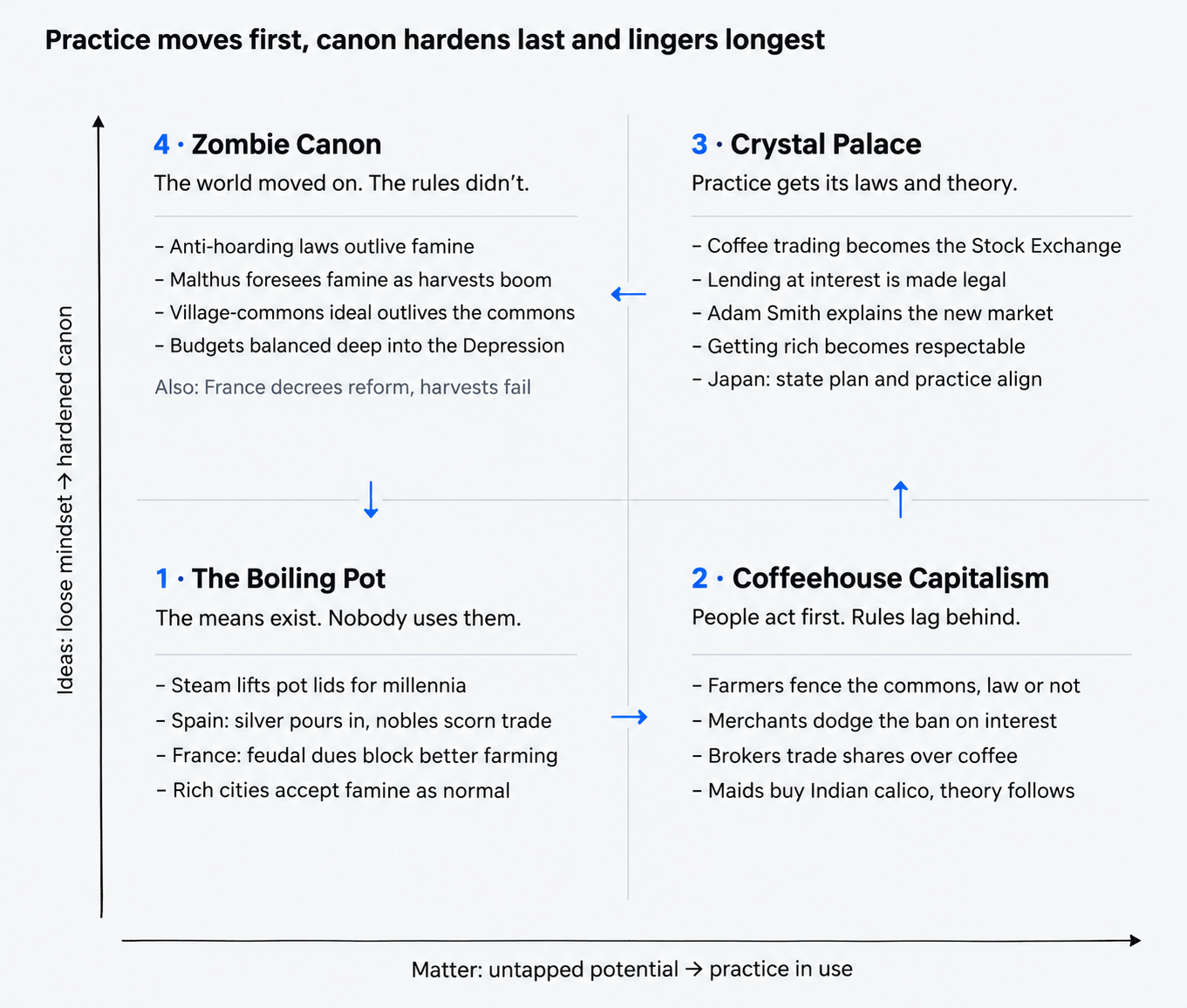
Examples from Appleyby's Relentless Revolution, the rest is my vibe theory
Read clockwise from the bottom left:
- The Boiling Pot: Material potential sits unused (1)
- Coffehouse Capitalism: Material Practice starts under an informal mindset (2)
- Crystal Palace: A canon hardens around the practice (3)
- Zombie Canon: The practice moves on and leaves the canon floating (4)
- The floating canon then shapes the next Boiling Pot.
This is very rough and not stresstested yet. But it seems plausible and I see some observations and insights from past book club readings resonate here. Maybe this can form something bigger later.
Some provisional follow-up thoughts:
- This could be read as a macro scale model ("This is how a big idea like capitalism is adopted and discarded by big entities like nations") or as a micro/meso scale model for smaller developments. I think the latter, smaller reading is more appropriate.
- While these four stages form a loop it seems also possible to leapfrog stages. Different kinds-of-capitalism and associated diverging capitalist attitudes can probably be traced as movements through these quadrants. The trailblazer England had the most time to run through all of these stages and hence may have generated a deeper canonization of classic capitalist ideas than fast followers like Germany or Japan.
- My contribution to the 2026 Protocol Symposium centered around the idea that Personal Time Management has become a kind of obsolete practice which is still shaping the discourse around dealing with time - I think this model here could provide an explanation for the causal development that led to this point. It seems worth a try to link these.
- Naturalization of contingent ideas, the thing Appleby works against in her history of capitalism, happens at the Crystal Palace stage. Here lived material practices align with canonized theory and maybe it is this very alignment that enables naturalization of man made things like economic theories.
Lets see what to make of this.
v3
“fixed a linebreak”